 IRSFP
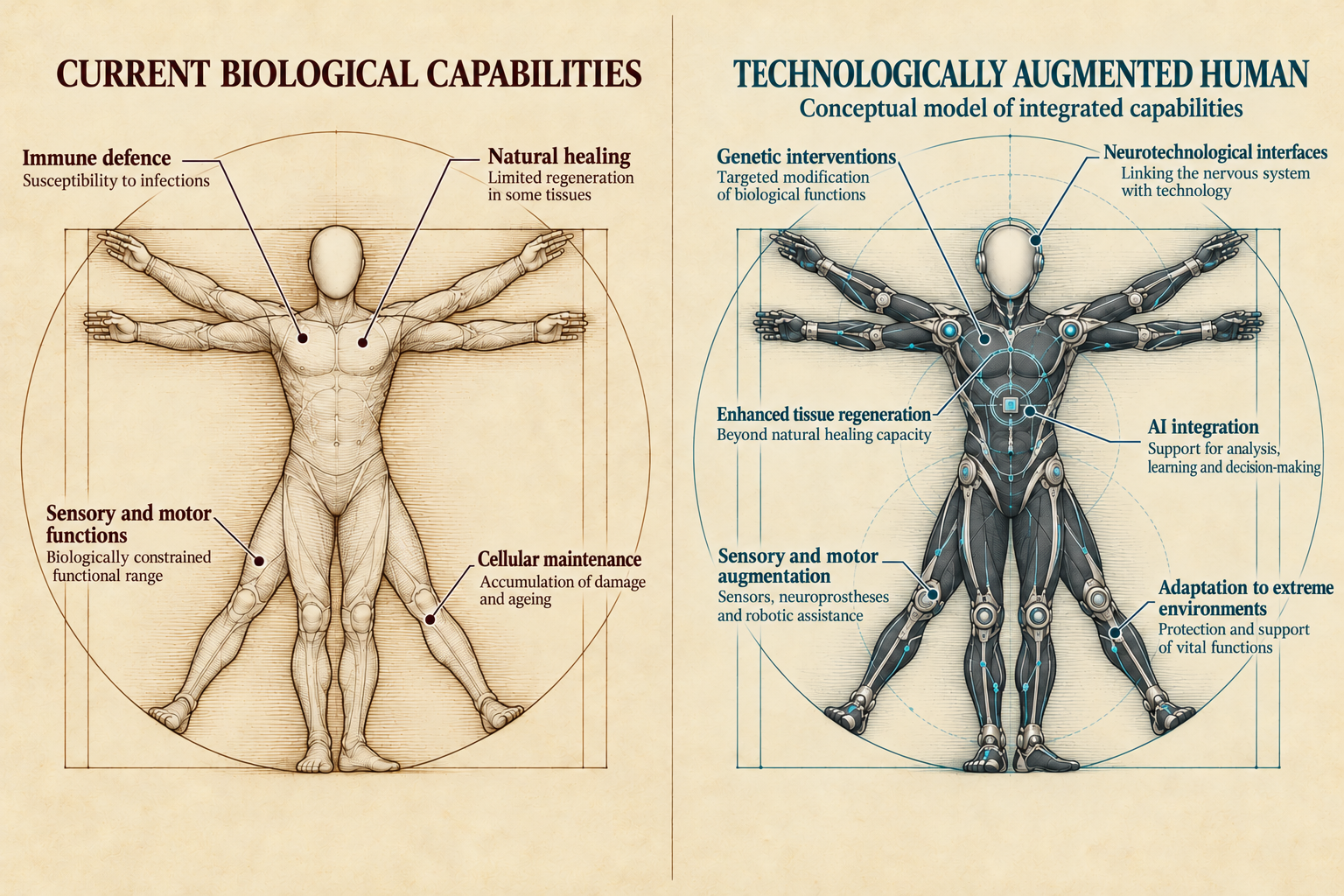
Technology has entered a phase where the capacity to modify the external environment outpaces the evolution of the human body itself. Artificial intelligence, gene editing, neuro‑interfaces, and advanced robotics give us tools to *reshape* reality, but they also highlight a growing mismatch: our biology is still bound by the limits of immune defence, natural healing, sensory‑motor function, and cellular maintenance. The question is no longer *what* we can build, but *how* we should integrate those capabilities with the organism that ultimately wields them.
The Vitruvian Contrast: Biology vs. Augmentation
The infographic supplied for this article adopts Leonardo da Vinci’s iconic Vitruvian Man as a scaffold for two contrasting visions. On the left, CURRENT BIOLOGICAL CAPABILITIES enumerate the innate constraints of a human body – a modest immune system, self‑repair mechanisms that operate on relatively slow timescales, limited sensory resolution, and a finite capacity for muscular and neural coordination. On the right, TECHNOLOGICALLY AUGMENTED HUMAN portrays a speculative future where genetic interventions fine‑tune cellular pathways, neuro‑technological implants create bidirectional brain‑computer links, tissue regeneration is accelerated by synthetic scaffolds, artificial intelligence augments cognition, and sensory‑motor augmentations enable survival in extreme environments. The side‑by‑side layout makes the disparity visually explicit: machines can process data orders of magnitude faster than the brain, while the body remains a passive carrier of those enhancements.
Ethical Crossroads: From Enhancement to Inequality
The rapid expansion of augmentation technologies raises profound ethical concerns. If enhancement remains a luxury accessible only to a privileged few, society may split into *augmented* and *non‑augmented* strata, exacerbating existing inequalities. Moreover, delegating decision‑making to AI‑driven implants threatens personal autonomy; the line between assistance and substitution can blur when neural interfaces begin to dictate perception or behaviour. These scenarios compel us to ask: Where does support end and manipulation begin?
A balanced approach would demand that research not solely chase external performance gains but also invest in strengthening the underlying biology. Strategies could include improving innate immune resilience, accelerating natural tissue repair, or expanding the brain’s capacity for long‑term memory without invasive hardware. By enhancing the biological substrate, we reduce reliance on external prostheses that may become points of failure or control.
Towards a Balanced Future
The path forward calls for an interdisciplinary dialogue that unites technologists, biologists, ethicists, and policymakers. We must develop frameworks that:
- Prioritise equitable access to safe, evidence‑based augmentations.
- Safeguard autonomy by ensuring users retain ultimate control over any neural or cognitive interface.
- Invest in biological resilience to complement, rather than replace, technological tools.
Only by addressing these pillars can we avoid a future where technology merely *replaces* the human mind and body, and instead foster a symbiotic evolution where both realms advance together. The Vitruvian illustration serves as a reminder: progress is most meaningful when it respects the integrity of the organism it intends to empower.
The conversation is yours to shape. What limits should we set on intervening in our own biology? How can we ensure that the quest for a “god‑like” existence enhances, rather than erodes, the very humanity we seek to transcend?
Sources
- A Hidden One-Dimensional Invariant in Late-Time Cosmology
10.5281/zenodo.19365588 - IET: A Physical Analytical Method for Computing the Energy–Information–Time Relationship
10.5281/zenodo.18146906