 IRSFP
Abstract and scientific scope
The IRSFP cosmology programme investigates alternative descriptions of gravitational and cosmological dynamics. Conceptual originality is not the deciding criterion: the model must be mathematically consistent, and its predictions must be compared against the same observational data used by the reference ΛCDM model.
Why ΛCDM is a formidable benchmark
The standard ΛCDM cosmological model successfully describes much of the measured expansion and structure of the Universe. Yet the physical nature of dark energy and the value of the cosmological constant remain deeper open questions. R-Universe seeks alternative interpretations of these phenomena, but proposing a new verbal account is not the scientific test. What matters is deriving predictions that can be calculated and compared with data.
From a relation to measurable predictions
One earlier branch of R-Universe explores an interpretation of late-time cosmic evolution as a renormalisation-group flow of the vacuum sector with the Hubble scale. The proposed relation ΩΛ = θ/(θ + 1) connects the effective dark-energy fraction with a hypothetical critical exponent. For ΩΛ of approximately 0.69, θ is approximately 2.2. This numerical correspondence provides theoretical motivation; it is not a microscopic derivation of dark energy.
What must be compared
Competing models must be tested against the expansion history, supernova observations, baryon acoustic oscillations, the cosmic microwave background and other compatible data. Perturbation behaviour, physical stability and local gravitational constraints are also essential. A good fit to a single quantity cannot establish empirical superiority.
Why Bayesian evidence matters
Comparisons must distinguish the best fit found from evidence that accounts for the full admissible parameter space and model complexity. In the updated KGB branch, the author's analysis reports Δ log Z = +0.524 ± 0.592 relative to ΛCDM. This small difference is comparable to the numerical uncertainty; it does not support a claim that the new model convincingly outperforms standard cosmology.
A research programme, rather than a single completed theory
RCD, RFG and KGB are distinct construction branches. Without additional evidence, they cannot be presented as a single unified physical theory. The programme's scientific value lies in progressively clarifying its assumptions, local limits and tests capable of ruling out a particular branch.
Papers and public research records
Related public records and identifiers are listed below. A DOI does not, by itself, establish the correctness of findings or guarantee peer review.
- R-Universe – theoretical RG branch (preprint) — DOI: 10.21203/rs.3.rs-9097693/v1 ↗
- Current RCD/KGB record — DOI: 10.5281/zenodo.22799606 ↗
Read also
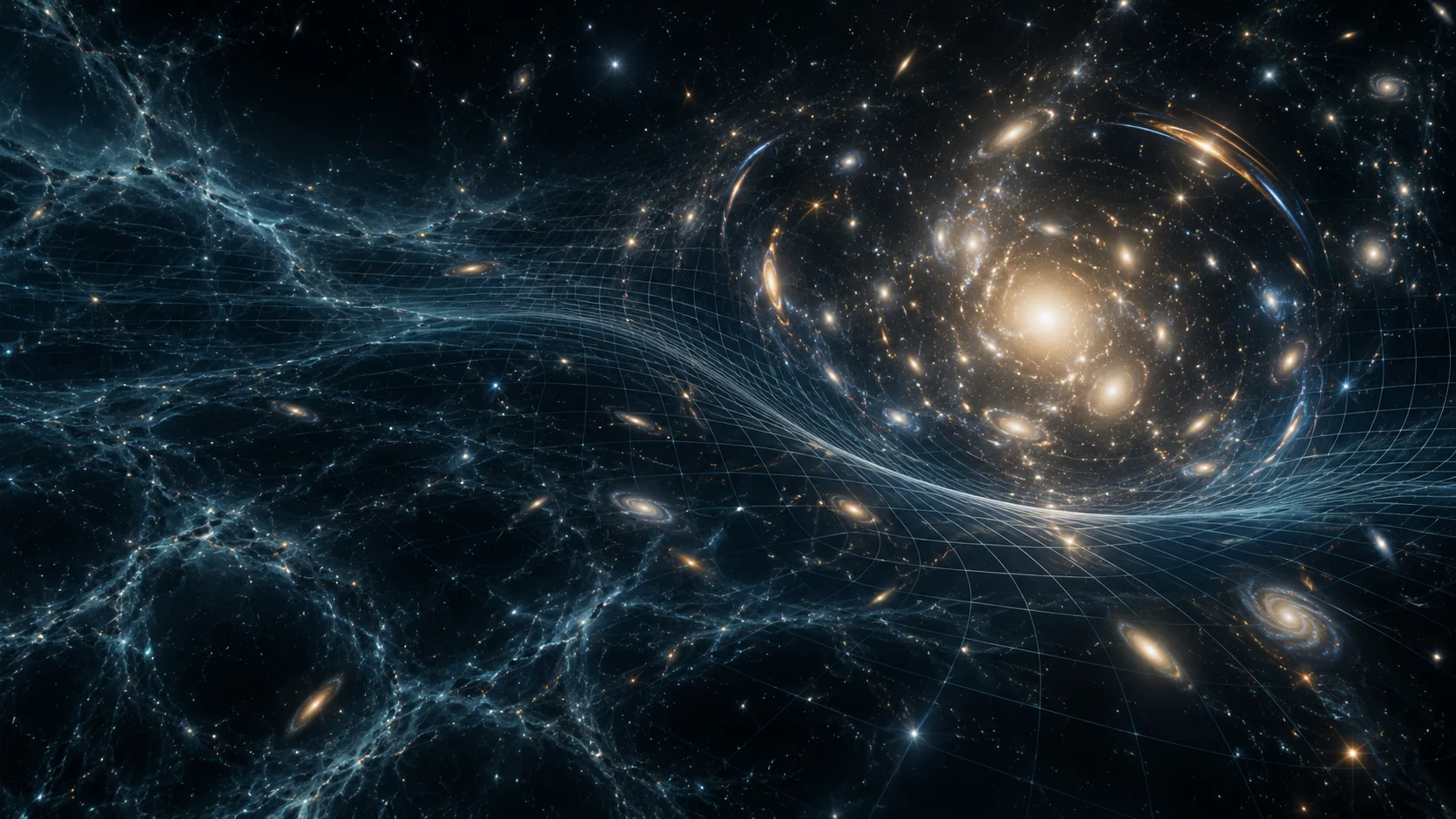
The opening graphic is a conceptual thematic illustration, not an experimental record.