 IRSFP
Definition and Rationale
Acute clinical deterioration in intensive‑care units often unfolds silently, driven by subtle shifts in the dynamics of vital‑sign signals. Conventional monitoring relies on static thresholds that may miss the loss of systemic resilience that precedes overt decompensation. The Physiological Stability Index (PSI) is presented as a retrospective computational framework that captures *dynamic* physiological instability. It is explicitly framed as a testable model of systemic fragility, not as a diagnostic device or a replacement for clinical judgment.
Core Components of PSI
PSI aggregates four mathematically defined components, each reflecting a distinct aspect of physiological dynamics:
- Perturbation Intensity – quantifies the magnitude and frequency of excursions from a baseline state.\
- Autocorrelation Persistence – measures lag‑1 autocorrelation, which tends to rise when the system exhibits critical slowing down.\
- Relaxation Dynamics – estimates the recovery rate (λ) of the system after a perturbation, derived from the decay of autocorrelation.\
- Coupling Changes – tracks time‑varying inter‑subsystem relationships, such as heart‑rate‑blood‑pressure coherence.
These components are computed from publicly available ICU time‑series (PhysioNet/CinC Challenge 2009, eICU Demo 2.0.1, Challenge 2012 and 2019). The resulting global PSI score is intended to reflect the overall balance between perturbation amplification and dissipative recovery.
Performance Metrics and Key Limitations
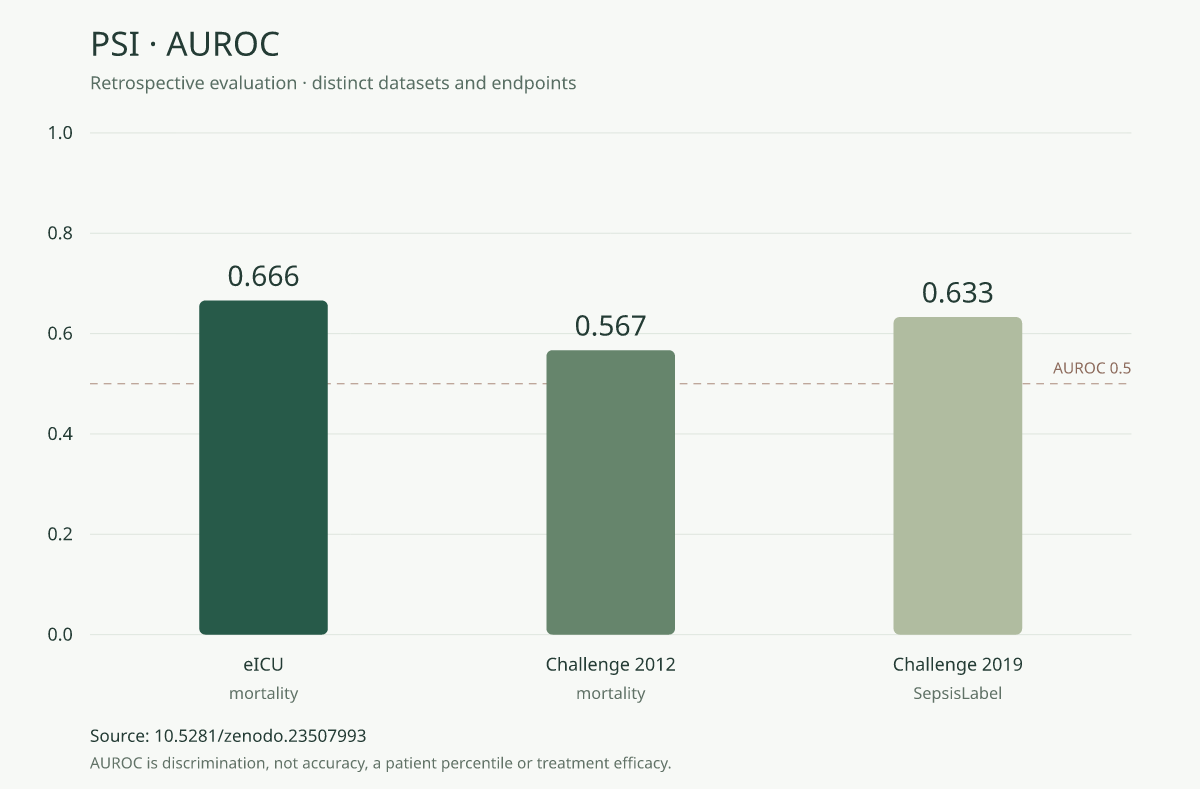
The open retrospective evaluation reported the following discriminative performances against established endpoints (doi:10.5281/zenodo.23507993):
- eICU mortality – AUROC 0.666\
- Challenge 2012 mortality – AUROC 0.567\
- Challenge 2019 SepsisLabel presence – AUROC 0.633\
A focused window‑level analysis of Challenge 2012 Set A (3,908 episodes, 163,667 valid windows) produced an AUROC of 0.593 (95 % CI 0.558–0.599) and an AUPRC of 0.443 (95 % CI 0.398–0.450).
Importantly, several negative findings temper enthusiasm:
- An isolated DC component outperformed the full PSI in the local proxy task, suggesting that a single spectral feature may capture more relevant information than the composite index.
- A simple mean of component values slightly exceeded the performance of PSI‑v2 in the Challenge 2019 dataset.
- Adding PSI to episode‑level mortality models based on SAPS‑I, SOFA, or their combination did not improve predictive accuracy.
These results indicate that, while PSI extracts a measurable signal from ICU data, its incremental clinical value over established scores remains unproven. The authors stress that the current work does not constitute clinical validation, calibration, or a reliable alarm system. Prospective shadow‑mode testing, patient‑level external validation, and false‑alarm rate assessment are required before any bedside application.
Visualisation Recommendations for Future Publications
To make PSI accessible to clinicians and informaticians, the following visual assets are recommended:
- Schematic diagram illustrating the four PSI components and their mathematical relationships.\
- Time‑series plots showing PSI trajectories in the hours preceding documented decompensation events, highlighting any lead‑time patterns.\
- ROC and AUPRC curves reproducing the reported AUROC and AUPRC values, with confidence‑interval shading to convey uncertainty.
These graphics should be presented in high resolution, employ a consistent colour palette, and include clear axis labels (e.g., PSI score, time to event, false‑positive rate). Caption texts must reference the exact performance numbers and DOIs to maintain traceability.
Outlook
PSI demonstrates computational feasibility and reveals a non‑random, albeit limited, dynamic signal in open‑source ICU datasets. Its transparent, component‑based design aligns with emerging interests in explainable AI for medicine. Nevertheless, the current evidence base is restricted to retrospective analyses without external or prospective validation. Future work must lock the analytical protocol, evaluate calibration across diverse patient populations, and quantify false‑alarm burden per patient‑day before PSI can be considered for real‑time clinical monitoring.
*The article reflects the findings and limitations presented in the original study (doi:10.5281/zenodo.23507993) and does not introduce any unpublished data.*