 IRSFP
How can we tell when a complex biological system is losing its ability to return to equilibrium? Two IRSFP research directions explore this question in different settings. PSI works with physiological time series, while OSD develops a hypothesis about pathological states in tumour systems. Their findings should therefore be considered separately.
PSI: a measurable signal with clear limits
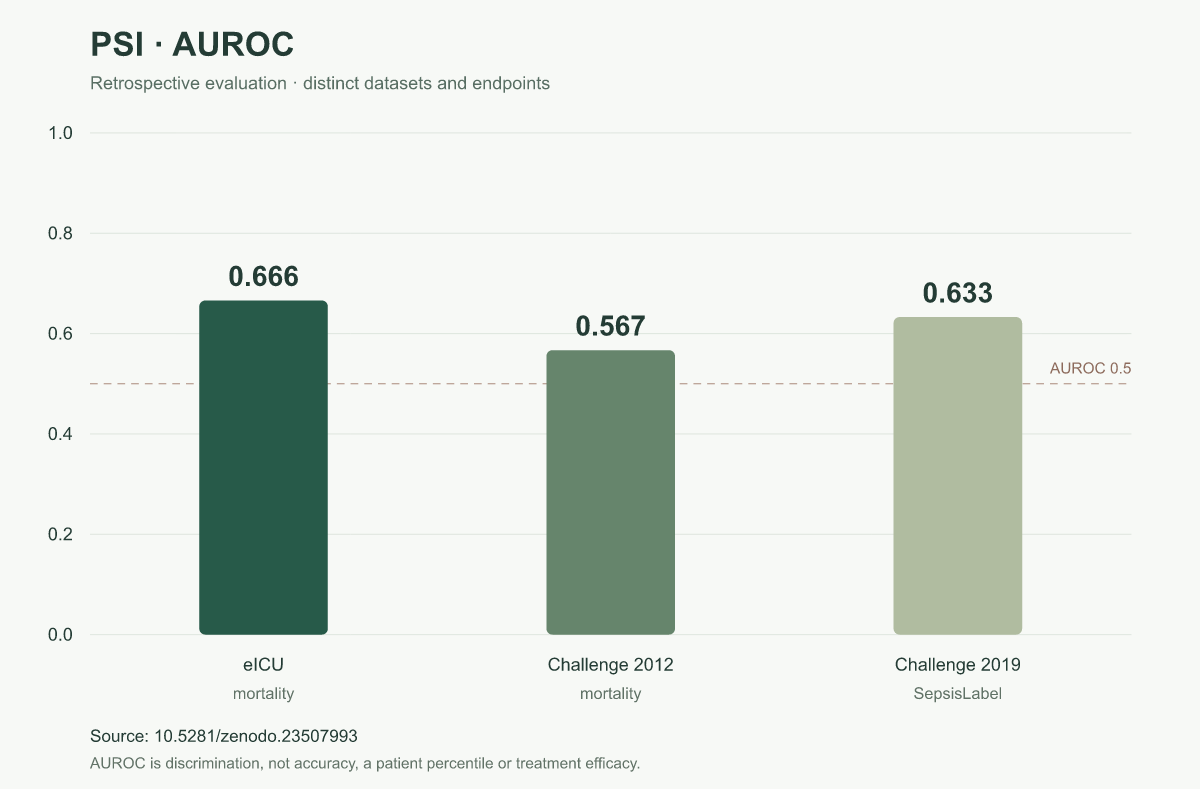
The retrospective Physiological Stability Index study reports an AUROC of 0.666 for eICU mortality, 0.567 for Challenge 2012 mortality, and 0.633 for the presence of at least one positive SepsisLabel in Challenge 2019. These values describe discrimination against different endpoints, not percentage accuracy or an individual patient's risk. The accompanying chart reproduces these three published values.
The negative findings matter too. The isolated DC component outperformed global PSI in a local proxy task, and a simple component mean slightly outperformed PSI-v2 in Challenge 2019. Adding PSI did not improve the evaluated mortality models based on SAPS-I, SOFA, or their combination. The study supports computational feasibility and a limited signal, rather than established clinical benefit.
OSD: a protocol for testing a hypothesis
OSD Laboratory Protocol v1.0 proposes preclinical testing of whether a tumour model can be durably displaced from a pathological state. It distinguishes a change of state from a reduction in cell viability alone. The protocol itself does not demonstrate a successful biological reset or treatment efficacy; it sets out the research framework needed to test the hypothesis.
What further research must establish
For PSI, the next steps include patient-level external testing, prospective evaluation, calibration, and assessment of false alarms. For OSD, the proposed experimental testing must first be carried out. Both directions offer a testable question about stability. Their further significance must be determined by the results of the appropriate studies.